

It’s 10:40 on a Tuesday morning in the thick of tax season. A tax manager hits refresh on a return in UltraTax for the third time. Nothing. The server hosting the firm’s practice management software has locked up, and twenty-five preparers and reviewers are staring at spinning wheels instead of billing hours.
Somebody calls IT. A pleasant voice on the other end says a ticket has been logged and someone will call back within four to eight hours.
Four hours. In the middle of April.
That gap between “ticket logged” and “problem solved” is where accounting firms bleed money every single tax season, and most managing partners never see the number until it’s already gone.
What a two-hour outage actually costs
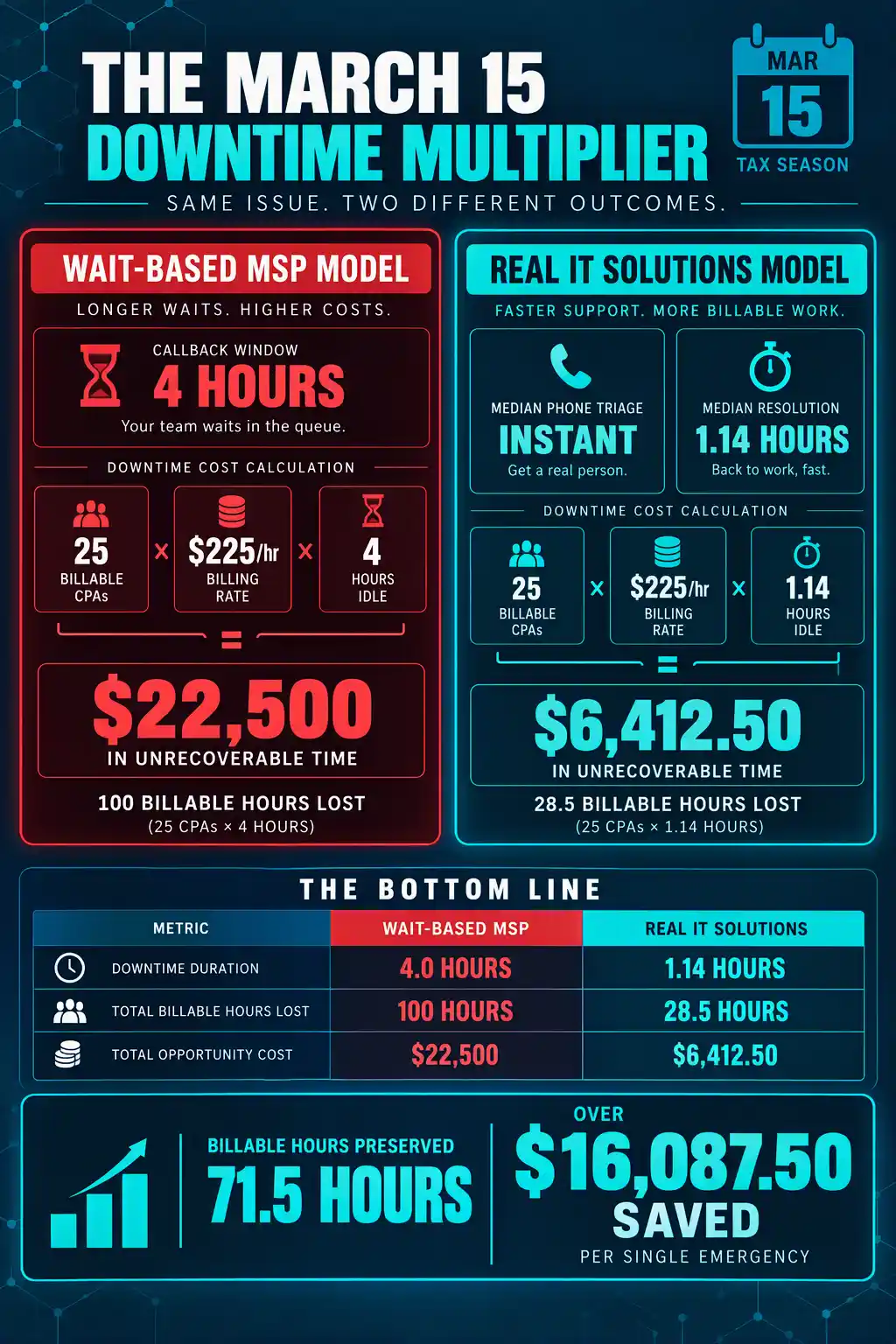
Do the math on a mid-size firm. Twenty-five billable preparers and reviewers, billing at a conservative $225 an hour, produce $5,625 in revenue every hour the firm is fully operational. Freeze that production for two hours and the firm has burned somewhere between $11,000 and $14,000 in unrecoverable billable time, money that doesn’t show up anywhere on a budget line until the partners wonder why realization dropped in April.
And in tax season, lost hours don’t roll over to next week. Staff is already pulling 60- to 70-hour weeks. A two-hour outage doesn’t get made up tomorrow. It becomes a missed filing deadline, a scrambled extension, or a client who’s irritated that their return isn’t ready.
During tax season, IT support for CPAs isn’t about convenience. It’s about whether the firm hits its deadlines.
Why does the typical help desk model make this worse?
Most managed service providers run on a dispatcher model. A ticket comes in, it drops into a shared queue with everybody else’s problems, and a technician calls back whenever they get to it. For a firm whose entire practice runs through one line-of-business application, that queue model is the enemy.
West Michigan clients who’ve worked with other providers describe the same pattern: calling in a critical outage and waiting a full business day, sometimes two, before a technician actually picks up the phone and starts working the problem. By the time anyone touches the server, that day’s billable hours are already lost.
The fix isn’t a nicer apology email. It’s a different operational model for accounting firms, one built specifically so a frozen practice management server gets a technician on it in minutes, not hours.
What does fast actually look like, with real numbers?
Here’s what that looks like when it’s built into the service model instead of promised in a sales pitch. Pulling critical-priority tickets from an actual Q1 tax season (January 15 through April 15), filtered to exclude automated monitoring noise, phone-reported emergencies had a median first response time of 0.00 minutes. Every single one was picked up live, not routed to voicemail or a call center overseas.
Median resolution time on those critical phone emergencies: 1.14 hours. Over half were closed in under two hours. Three-quarters were resolved the same day.
Look at the actual ticket titles behind those numbers:
“Practice Management Down,” resolved in 12 minutes.
“QuickBooks Down,” resolved in 1 hour.
“Internet Issue, Phones Down,” resolved in 1 hour.
“Server Down,” resolved in 2.4 hours.
Run the firm’s billing math against that 1.14-hour median instead of a four-hour callback window, and the firm saves about $10,000 to $12,000 in billable capacity on a single outage. That’s not a marketing claim. That’s what happens when “Priority 1: Critical” means a technician is already working the problem while the dispatcher model is still writing up the ticket.
It’s not just speed; it’s accountability
Fast response alone isn’t the whole story. A ticket that gets closed quickly but doesn’t actually fix the root cause just means the same server locks up again in two weeks, right when the firm can least afford it.
That’s why a critical ticket shouldn’t close the moment a technician steps away from the keyboard. It should get a second set of eyes, a service manager reviewing the work to confirm the real issue is fixed, not just the symptom, and that the quick fix didn’t open a gap in the firm’s cybersecurity. That extra step is the difference between “the server’s back up for now” and “the server’s not going to do this again during crunch.”
Firms also do better when they set expectations before day one, not discover them during a crisis. New clients should get walked through exactly when to send a quick email and when to pick up the phone because a process has stopped. That training removes guesswork in the moment it matters most, and you should revisit it around the 45-day mark and again heading into the next quarter, not leave it as a one-time orientation nobody remembers by March.
What to do this week
If you’re a partner or operations lead at an accounting firm, pull your own numbers before next tax season puts you back in the hot seat. Ask your current IT provider two questions: what’s the median time from “I called” to “a technician is actively working my problem,” and what’s the median time to full resolution on a critical, practice-stopping issue. If they can’t answer both with real numbers pulled from their own ticketing system, you don’t actually know what an outage is going to cost you until it happens.
Then run your own version of the math above. Take your billable headcount, multiply by your average rate, and ask yourself honestly what a four-hour callback window costs you on April 10th. That number should be the real deciding factor in who answers your firm’s emergency line, not a glossy brochure.