
AI Prompt Engineering Training
The CRAFTED FRAMEWORK
The Single Biggest Factor in AI Output Quality Is How You Ask the Question. As part of our broader AI Business Optimization services, Real IT Solutions teaches your team the CRAFTED Framework — a seven-component prompting method developed by Chief AI Officer Donald McArthur — so every person in your business knows exactly how to ask for what they need, the first time.
- Seven-component CRAFTED Framework — Context, Role, Audience, Format, Tone, Explain, Deliverable
- Half-day or full-day workshop format for employee groups
- Tool-agnostic — works with Microsoft Copilot, ChatGPT, Claude, and Gemini
- Take-home reference card and prompt library starter

Why Prompt Engineering Matters
Not a Tool Problem — an Ask Problem
Most employees using ChatGPT or Copilot type the way they’d text a coworker, hit enter, and hope. What comes back reads fine and is often wrong in ways that don’t show — a flattened detail, a guessed-at fact, a tone that undersells what’s actually going on.
AI tools produce inconsistent results almost entirely because of how they’re asked, not what they’re capable of. Search “prompt engineering” today and most of what comes back is marketing advice — catchier ad copy, better content calendars. That’s not wrong, exactly. It’s just aimed at a different audience. Inside most businesses, the highest-stakes prompts aren’t creative at all. They’re technical: a summary that becomes a customer-facing email, a policy explanation that becomes the record someone points back to later, a report that gets forwarded without a second read.
Nobody wrote a framework for that — so most employees default to short, context-free prompts, get back something that sounds confident and is quietly wrong, and spend twenty minutes fixing it by hand. The fix isn’t a better AI tool. It’s a better ask — which is exactly what the CRAFTED Framework teaches.
Introducing the CRAFTED Framework
A Seven-Component System, Not a Slide Deck
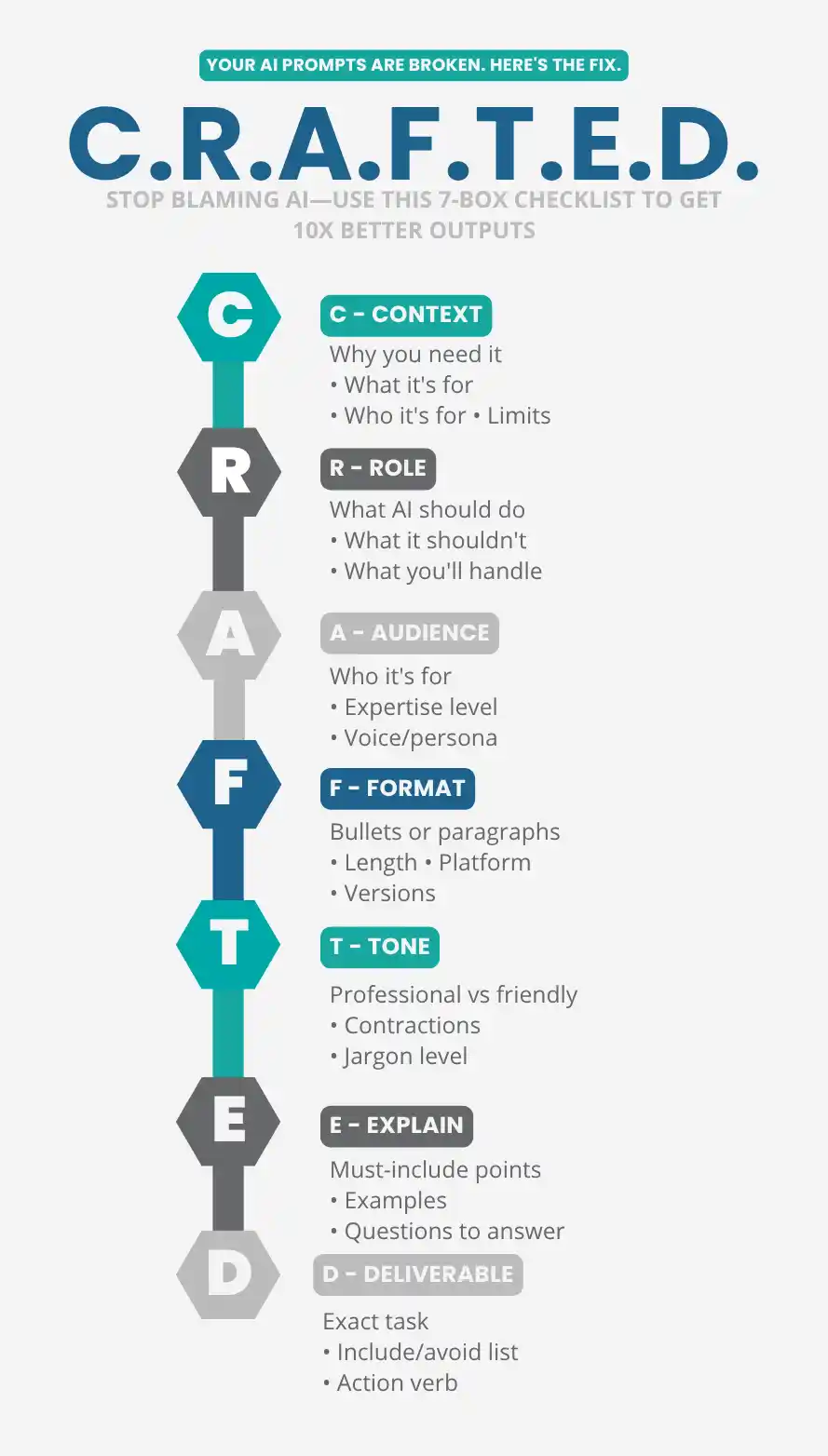
Donald McArthur developed CRAFTED to teach prompt engineering in half-day workshops for professional teams — seven components you can run through in under a minute before you type anything into an AI tool.
| Letter | Stands For | What It Does |
|---|---|---|
| C | Context | The relevant facts, constraints, or background the AI can’t guess on its own. |
| R | Role | Who the AI should act as — a quality engineer writing for an audit trail responds differently than a generalist assistant. |
| A | Audience | Who actually reads this. A coworker, a customer, and a company president all need something different from the same facts. |
| F | Format | The structure the output needs — specific fields, a short paragraph, a table. |
| T | Tone | Factual and neutral, reassuring but honest, or terse — set on purpose instead of left to chance. |
| E | Explain | Tell the AI to flag what it’s unsure about rather than guessing. This matters more in technical writing than anywhere else. |
| D | Deliverable | The specific, finished thing you want back — not “some information about this,” but the actual document. |
It’s a checklist, not a script you write out in full every time. Once a team internalizes it, most of it becomes habit — but writing it out the first several times is what breaks the “just clean this up” reflex.
How the Training Works
Built for Real Teams, Not a Certificate
Teach Your Team to Ask AI for Exactly What They Need – A CRAFTED Framework workshop turns inconsistent AI output into a repeatable process — in half a day, with no new tools to buy. Our Grand Rapids-based team will build training around your business’s actual processes.
- Half-day or full-day workshop format for employee groups
- Tool-agnostic — works with Microsoft Copilot, ChatGPT, Claude, and Gemini
- Hands-on practice using real scenarios from your business, not generic examples
- Take-home reference card and a prompt library starter your team keeps using after the session ends
Pick one document type your team produces constantly — client emails, internal reports, policy summaries — and we’ll build your first CRAFTED-structured prompt template around it during the session.
Who This Training Is For
Is This You?
AI adoption rarely stays in one department. Once leadership signs off, it shows up everywhere — the shop floor, the sales team, the front office — and every one of those groups asks AI for something different, with different stakes if the answer comes back wrong. CRAFTED training gives your CEO and leadership team a single method to roll out across the whole business, so the quality of what comes back doesn’t depend on which department is doing the asking.
- Leaders who need AI output they can trust — without double-checking every draft that comes back.
- Teams already using Copilot or ChatGPT informally — with wildly inconsistent results and no shared method for asking.
- Operations, quality, or customer-facing teams producing documents that become the record — work orders, reports, client communications.
- Production and shop-floor teams — shift handoffs, safety notices, and maintenance records the next shift has to act on without guessing.
- Sales teams — proposals, follow-ups, and customer emails that need to read consistently no matter who on the team is writing them.
- Accounting and finance teams — reconciliations, reports, and anything that becomes part of the financial record, where a confident guess is worse than no answer at all.
If any of these describe a team in your business, CRAFTED training is the fastest way to turn AI from a novelty into something every department can actually rely on.
How This Benefits Your Business
The Payoff Compounds Over Time
A single well-structured prompt saves a few minutes. A team that’s internalized CRAFTED saves those same minutes on every document, every day, indefinitely — and the payoff goes well beyond speed.
- Fewer costly mistakes — ambiguous AI output gets flagged instead of quietly guessed at, before it reaches a customer, an auditor, or the next shift.
- More professional, consistent communication — client emails, reports, and proposals read the same whether your newest hire or a 15-year veteran drafted them.
- Real operational efficiency — less time spent rewriting AI drafts by hand, more time spent on the work that actually needed a person.
- A skill that compounds — unlike a one-off tool or template, CRAFTED travels with your team across every AI product you adopt next.
None of this requires new software or a bigger AI budget — just a half-day workshop and a method your whole team keeps using long after the session ends.
GET YOUR FREE
AI Readiness Assessment
Are You Actually Ready For AI?
Every AI initiative starts in a different place.
Real IT Solutions’ free, five-dimension diagnostic tells you exactly where your
business stands before you spend a dollar on tools, training, or a workshop.
CRAFTED EXAMPLES in the Manufacturing Industry
The Maintenance Work Order
From Shorthand Notes to a Handoff Anyone Can Act On
A technician’s shorthand notes — half-finished sentences, abbreviations only the day shift understands — get pasted into an AI tool with a prompt like “clean this up.” The result often reads well and is quietly wrong, because the model resolved an ambiguous abbreviation with a confident guess instead of a flag. A CRAFTED version sets the Role as a maintenance supervisor preparing a handoff, the Audience as the next shift and the parts desk, the Format as a structured work order with clear fields, and — critically — the Explain instruction: flag anything ambiguous instead of resolving it silently. The next shift gets a document they can actually act on, with genuine gaps marked instead of papered over.
The Quality Report
 Facts Only — No Speculation in the Record
“Write up this defect” tends to produce something that reads confidently but drifts into speculation — assigning a probable cause the AI wasn’t actually given evidence for. In a document that may support a customer response or an audit trail, that’s a liability, not a convenience. A CRAFTED version sets the Role as a quality engineer documenting for an audit record, the Tone as strictly factual — no root-cause speculation unless it’s confirmed — and the Deliverable as the specific report fields the quality system already uses. What comes back is something a manager can sign off on without a rewrite.
The Customer Schedule Update
One Consistent Message, No Matter Who’s Writing It
“Tell the customer the order is late” is a fast way to send an email that either overpromises a new date or undersells that the delay is still within contract terms. A CRAFTED version sets the Audience as the customer’s contact — not an internal update — includes the actual Context (root cause, contract terms, a realistic new date), and keeps the Tone professional without over-promising. The message comes out consistent no matter which member of the team is drafting it that day.
The Safety Briefing
Clear for Veterans and New Hires Alike
“Turn this into a safety notice” often produces something that reads urgent for the wrong things and glosses over the actual hazard. A CRAFTED version sets the Role as a safety coordinator, the Audience as floor staff across every experience level — not just veterans who already know the shorthand — the Tone as direct without being alarmist, and the Explain instruction to flag anything the notes don’t make clear rather than smoothing it over. The result is a briefing new hires and twenty-year veterans can both actually use.
In all four cases, the underlying facts were exactly the same. The only thing that changed was how clearly the request was framed before the AI ever started generating. Manufacturing-specific use cases — production scheduling, supply chain communication, workforce training material — get their own deeper treatment on our AI for Manufacturing page.

Hello, I’m Donald McArthur, Chief AI Officer at Real IT Solutions. Let’s talk and discover if AI is right for your business.
Watch Donald Walk Through CRAFTED
See the Framework in Action
Prefer to watch it explained? Chief AI Officer Donald McArthur breaks down the CRAFTED Framework in this recorded session — the same material our workshops are built from.
Prompt Engineering Training — Frequently Asked Questions
Common Questions
Q: What is prompt engineering, and does my team actually need to learn it?
A: Prompt engineering is simply how clearly you ask an AI tool for what you need — the context you give it, the role you set, the format you specify. Most employees never learned it because nobody taught it; they default to typing the way they’d text a coworker and get inconsistent results back. If your team already uses Copilot or ChatGPT for anything beyond casual questions, structured prompting is worth teaching — it turns AI from a novelty into something they can actually trust.
Q: Can Real IT customize the prompt engineering workshop for our specific industry?
A: Yes. The CRAFTED Framework itself doesn’t change, but the workshop’s hands-on practice is built around document types and scenarios from your actual business — client emails, internal reports, quality documentation, whatever your team produces constantly — rather than generic examples that don’t transfer.
Q: What does each letter in the CRAFTED Framework stand for?
A: Context, Role, Audience, Format, Tone, Explain, and Deliverable. It’s a seven-component checklist developed by Chief AI Officer Donald McArthur that you run through in under a minute before typing a prompt — not a script you write out word for word every time.
Q: Does the CRAFTED Framework work with Microsoft Copilot, or only with ChatGPT?
A: It’s tool-agnostic. CRAFTED works the same way whether your team is using Microsoft Copilot, ChatGPT, Claude, or Gemini — the framework structures the request, not the tool that receives it. That’s part of the point: your team learns one method instead of a different set of tricks for every AI product you adopt.
Q: How long does it take employees to get proficient at prompting with CRAFTED?
A: Most teams internalize the framework within a couple of weeks of regular use after the workshop — the components become habit faster than you’d expect, especially once they see the difference in the output. Writing it out in full the first several times is what breaks the “just clean this up” reflex; after that, it’s mostly automatic.
Q: What is the difference between a basic prompt and a CRAFTED prompt?
A: A basic prompt is usually a few words — “clean this up,” “write this up,” “let the customer know” — with no context, role, audience, format, tone, or explanation attached. A CRAFTED prompt spells those seven things out, which is why the output tends to be accurate and usable on the first try instead of something you spend twenty minutes fixing.
Real IT Insights

AI Needs an Adult in the Room: A Practical Approach to Responsible AI Adoption
A few weeks ago, I participated in the panel Q&A discussion at the Better Business Bureau of Michigan’s BLAZE AI Summit in Grand Rapids.
Ready to Figure Out Where AI Actually Fits in Your Business?
An AI readiness conversation is the fastest way to cut through the noise — and find out what AI could realistically do for your team. Our Grand Rapids-based advisors will take an honest look at your current environment, identify where AI saves time and where it creates risk, and give you a clear, no-pressure recommendation. — Let’s talk.