
A business owner in Grand Rapids filed a complaint with his IT provider last tax season. His systems were down. His staff couldn’t bill, couldn’t file, couldn’t do the one thing a professional services firm absolutely cannot stop doing in the middle of March. He wanted answers about why nobody had called him back.
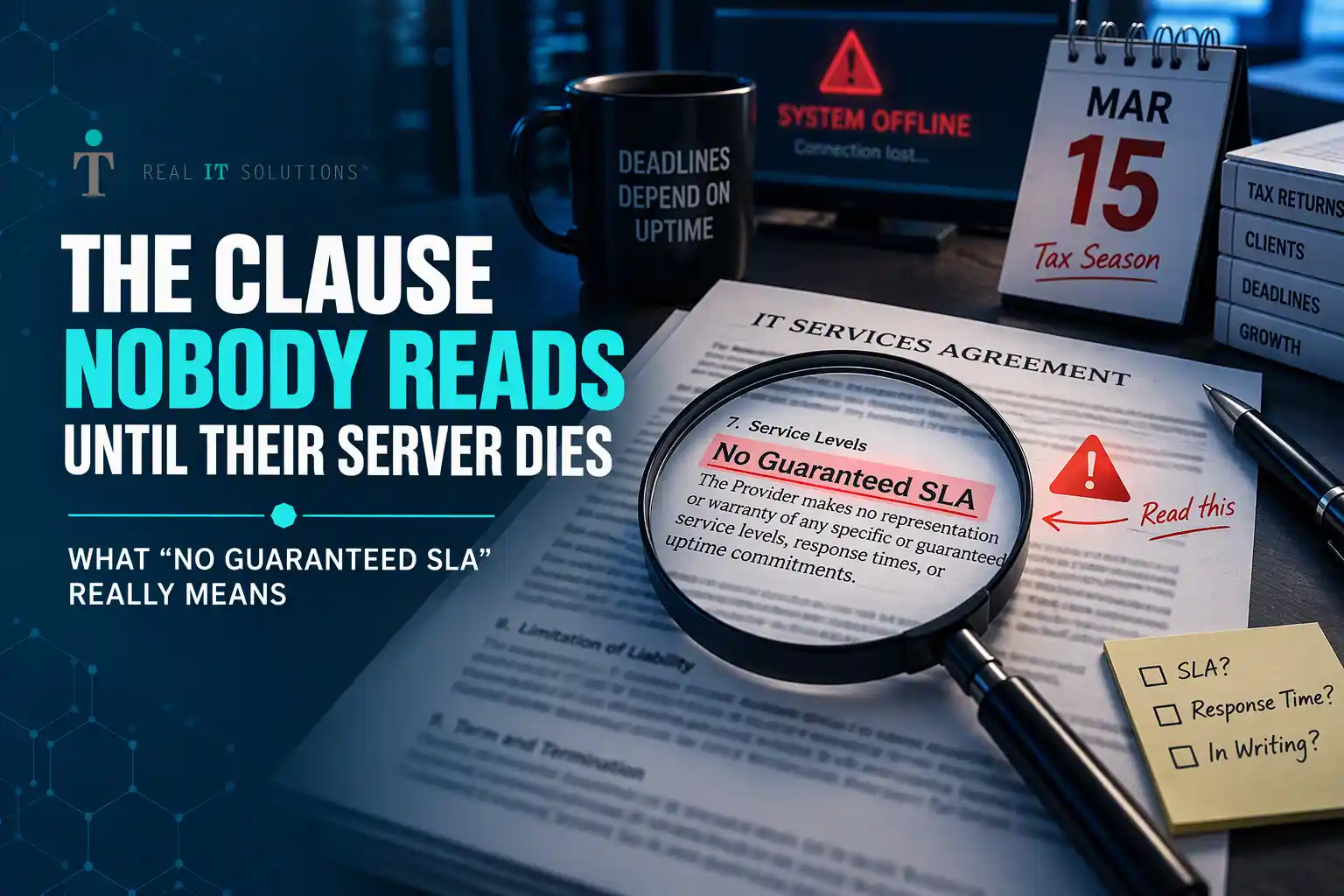
The provider’s response, in writing: “Our service contract and our Terms and Conditions have no specified or guaranteed SLAs.” Then, for good measure: “With no guaranteed service level, your concerns are not considered a material breach of contract.”
Read that again. He had a signed, multi-year contract with an IT company. He paid every invoice on time. And when his business stopped functioning, the provider’s own legal position was that they’d never actually promised to show up fast, so nothing had gone wrong on their end.
That’s not a bad month. That’s the business model.
What is a Service Level Agreement, and why does it matter here?
A Service Level Agreement, or SLA, is the part of an IT contract that’s supposed to spell out exactly how fast your provider will respond and resolve an issue, in writing, with a number attached. Most managed service provider (MSP) agreements mention an SLA somewhere. Very few actually commit to one.
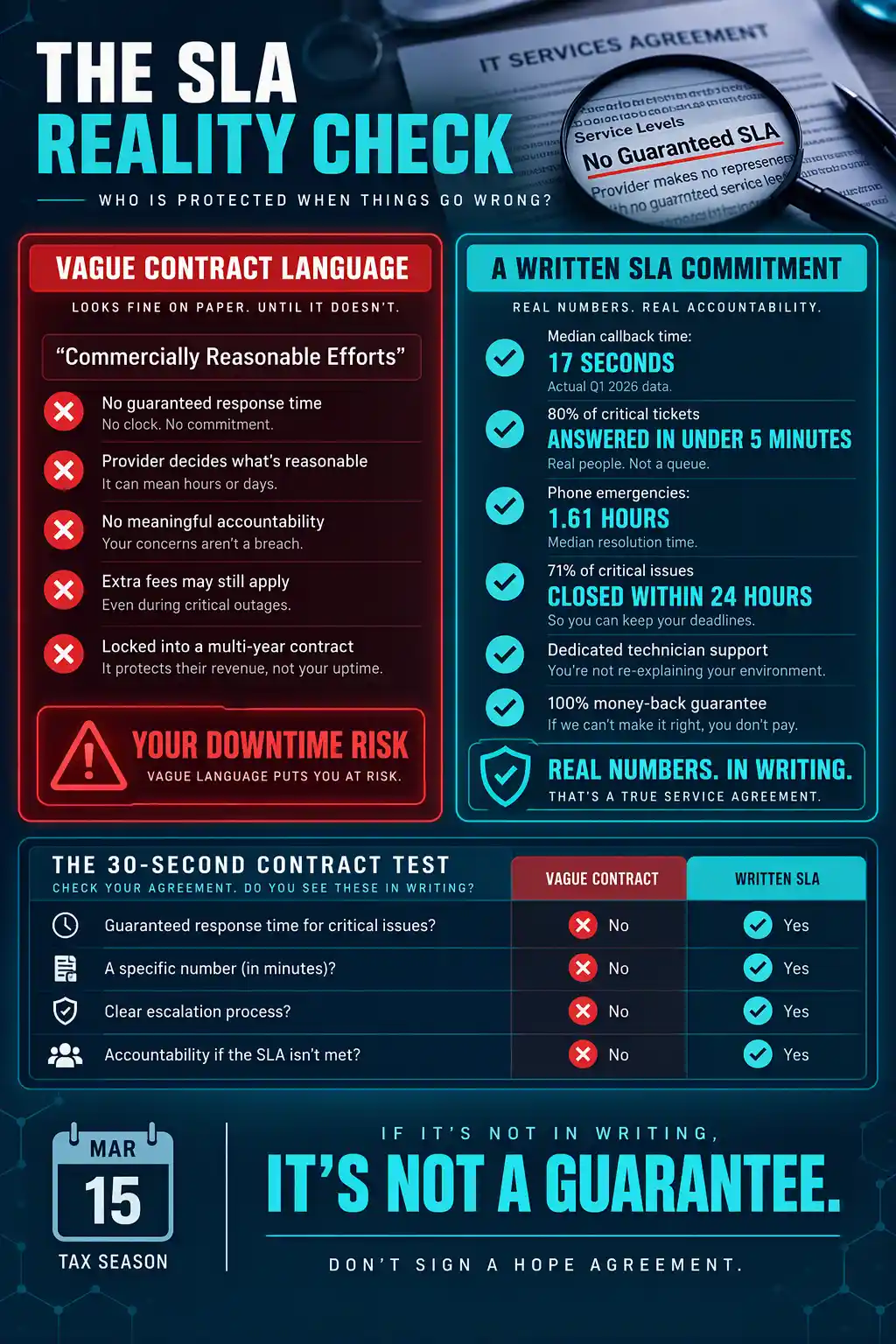
Most firms signing a three-year managed IT services agreement never make it to that section. They skim the pricing, check the term length, and sign. The response-time language, if it exists at all, often says something vague like “commercially reasonable efforts” — a real phrase from real contracts, not legal shorthand for anything specific.
That phrase sounds fine until the day it isn’t. “Commercially reasonable” has no clock attached to it. It can mean four hours. It can mean four days. The provider decides, after the fact, what was reasonable, and you’re the one locked into a three-year term with no leverage to walk.
Another Grand Rapids business owner described it plainly after being left without support for two straight days: “You will get no response from their team… I can’t wait to get out of this dang 3-year contract. It’s been terrible from the start and only gotten worse.”
That’s the trap. The contract protects the provider’s revenue for three years. It does not protect your uptime for three hours. And for a CPA firm in the thick of March or September deadlines — with UltraTax, Drake, or CCH Axcess down instead of running — three hours without a working line-of-business application isn’t an inconvenience. It’s billable hours, client deadlines, and in the worst cases, extension penalties walking out the door. (If you want the actual dollar math on what an outage like that costs a mid-size firm, we broke it down in The Real Cost of a Frozen Screen on March 15. This piece is about a different question: whether your contract even obligates your provider to show up fast in the first place.)
When should you hand off trust, and when should you hold on?
There’s a judgment call buried in every IT contract, and it’s bigger than price or feature lists. It’s the same question behind Real IT’s own Hand It Off or Hold On framework for deciding what a business should delegate versus keep ownership of: how much of your firm’s uptime are you willing to hand off to a vendor who won’t commit, in writing, to a number?
Handing off routine stuff to a vendor — patching, monitoring, backup verification — makes sense. That’s rules-based work. No judgment on the line, no relationship at stake.
But response time during a critical outage is not routine work. It’s the moment your provider’s judgment, urgency, and actual humans either show up or they don’t. That’s exactly the kind of thing you hold onto accountability for, because if the vendor won’t commit to a number, they’re telling you upfront that your emergency is negotiable on their end.
If a provider won’t put a response time in writing, they’ve already answered the question of how seriously they take your deadline. They just made you ask.
What does “in writing” actually look like?
We track every single critical ticket that comes through Real IT Solutions, filtered to strip out automated alerts and noise, down to real human response time. Year to date in 2026, the median callback time on critical tickets is 17 seconds. Tickets phoned in directly get an active human response in under a minute in the very large majority of cases. More than 80 percent of all critical tickets get an active human response in under 5 minutes.
Resolution matters as much as response. Median close time on critical tickets is 5.25 hours. For phone-in emergencies specifically, median close time drops to 1.61 hours. Over 71 percent of critical issues are fully closed within 24 hours.
Those aren’t marketing numbers. They’re pulled straight from our ticketing system, the same system that would show us looking bad if we were slow. We’re not hiding behind “commercially reasonable.” We’re putting the actual number on the table and standing behind it.
We also back a 100 percent money-back guarantee. If a client is ever dissatisfied with our service for any reason and we can’t make it right immediately, we refund the service fees in full. No three-year hostage contract required to force your business to stay.
And when a client calls, roughly 90 percent of the time they’re talking to the same dedicated technician who already knows their environment, their tax software, their quirks. Nobody’s re-explaining their setup to a stranger while the clock on their deadline keeps running.
Do small and mid-size firms really need a written SLA?
Yes, and here’s the test: if your IT provider can’t answer “what’s your guaranteed response time for a critical outage, in writing, with a number attached,” you don’t have a service agreement. You have a hope agreement. For a firm with 25 to 50 workstations running specialized software during a hard filing deadline, hope is not a plan.
A written, specific commitment isn’t a sales gimmick. It’s the only thing that gives you actual recourse when something breaks. Vague language protects the provider. Specific numbers protect you.
What to do this week
Pull out your current IT support contract and find the SLA section. If it says “commercially reasonable efforts” or doesn’t mention a response time at all, call your provider and ask them to put an actual number in writing: minutes, not hours, for critical outages. If they won’t, or they can’t, you already have your answer about who’s holding the risk in that relationship. It isn’t them.