

Walk any cybersecurity trade show floor and you will see the industry’s favorite story: the next tool will save you. AI-powered this, next-gen that, a new dashboard for every threat.
Then read the post-incident reports of actual small-business breaches, and a different story emerges. The way in was an unpatched server everyone forgot about. An account belonging to an employee who left fourteen months ago. A firewall rule added for a vendor project in 2019 that nobody ever closed. The breach was not exotic. It was inconsistency, found and exploited.
Standardization is a security control — arguably the most underrated one in IT. A standardized environment is one where every device, account, and configuration follows a documented baseline, every change follows a process, and every exception is visible. That consistency does more to prevent breaches than most security products, because attackers do not defeat your strongest control; they find the one place you forgot to apply it. After decades of designing and managing IT environments, I will make the unfashionable case that the discipline nobody demos at trade shows — documentation, baselines, checklists, and follow-through — is where real security lives.
KEY TAKEAWAYS
The Argument in Brief
- Breaches exploit inconsistency, not strength. Attackers find the one unpatched server, the orphaned account, the forgotten firewall rule — the gaps between your tools, not the tools themselves.
- Hygiene beats heroics. Microsoft’s Digital Defense Report concluded that basic security hygiene still protects against 99% of attacks.
- The industry sells tools because tools are sellable. Process is invisible, unglamorous, and not billable per license — which is exactly why it is underinvested and exactly why it works.
- Standardization is measurable. Patch reports, offboarding checklists, configuration baselines, and restore logs either exist in writing or they do not. There is no “pretty much documented.”
- A standardized environment is also an AI-ready environment. Tools like Copilot surface whatever your permissions allow — messy environments leak, standardized ones don’t.
THE BREACH USUALLY ISN’T EXOTIC
The Post-Incident Report Nobody Frames
Security marketing runs on the image of the brilliant attacker defeating sophisticated defenses. Reality is less cinematic. Verizon’s 2026 Data Breach Investigations Report found that organizations fully remediated only 26% of the known exploited vulnerabilities in their environments during the year — down from 38% the year before. Not zero-days. Known vulnerabilities, with patches available, sitting open. The same report found credential abuse in 39% of breaches — and a meaningful share of those credentials belong to accounts that should not have existed at all: former employees, expired contractors, service accounts nobody owns.
Microsoft’s Digital Defense Report puts the sharpest number on it: basic security hygiene — MFA enabled, systems patched, least-privilege access, data protected — still protects against 99% of attacks. Read that once more. The overwhelming majority of real-world attacks are stopped not by advanced tooling but by fundamentals applied consistently. The word that matters is consistently. Almost every business does the fundamentals somewhere. Breached businesses did them almost everywhere.
When we assess a new client environment in West Michigan, we almost never find “no security.” We find islands of good practice separated by gaps: the servers patched but the network gear forgotten, MFA on email but not on the VPN, an offboarding process that exists in someone’s head. Attackers are not looking for your strength. They are looking for your variance.
WHAT STANDARDIZATION ACTUALLY MEANS
Not Bureaucracy — Engineering
Standardization gets dismissed as paperwork, so let me define it as an engineer: a standardized environment is one where the correct configuration is documented, applied everywhere, verified on a schedule, and changed only through a process that leaves a trail. It is the difference between “our systems are patched” as a feeling and “here is this month’s patch report” as a fact. Here is what that looks like against the ways breaches actually start:
| Where Breaches Start | The Standard That Prevents It | The Proof It Exists |
|---|---|---|
| Unpatched known vulnerability | Documented patch cadence covering every system — servers, workstations, and network gear | A monthly patch report with exceptions listed and owned |
| Ex-employee account still active | Same-day offboarding checklist tied to HR, not memory | The completed checklist from the last departure, with timestamps |
| Forgotten firewall rule or configuration drift | Configuration baselines plus change control with expiration dates on exceptions | A change log that explains why every rule exists |
| Everyone is a local admin | Least-privilege standard — access granted by role, elevated by exception | An admin list short enough to read aloud |
| The server nobody knew existed | A living asset inventory — you cannot protect what you have not counted | An inventory reconciled against what the network actually shows |
| Backups that turn out to be broken | Scheduled restore verification, not backup hope | The date and result of the last successful test restore |
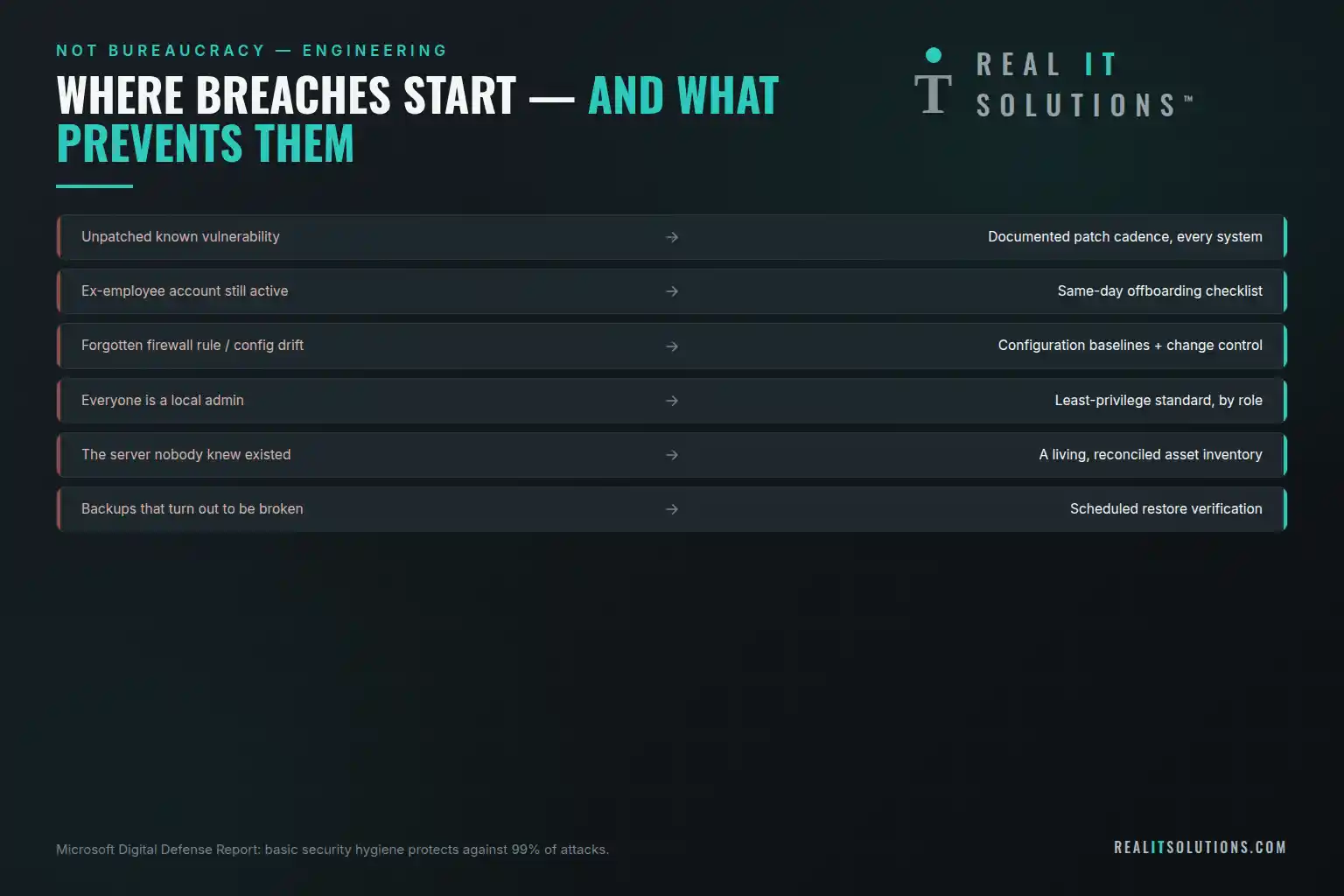
Notice the third column. Every standard produces evidence. That is the practical test of standardization, and it is the reason it improves security even before any attacker shows up: an environment that can prove its own state is an environment where drift gets caught early, by you, instead of late, by someone else.
WHY TOOLS KEEP WINNING THE BUDGET AND LOSING THE BREACHES
The Shiny Object Problem
If hygiene stops 99% of attacks, why does the spending flow the other way? Because tools are visible and process is not. A new security product produces a dashboard, a launch meeting, a feeling of decisive action. A patch cadence produces… nothing you can see. Just months that pass without incident, which is indistinguishable from luck until the day it isn’t.
There is also an honest structural reason: the security industry can sell you a product, but it cannot sell you follow-through. Follow-through is operational. It lives in whoever manages your environment day after day — which means the real security decision most small businesses make is not which tool to buy. It is who runs their IT, and to what standard. A brilliant tool operated inconsistently loses to a modest tool operated with discipline, every time. I have watched that outcome repeat for over two decades, and it is why our engineering culture treats a missing checklist as seriously as a missing firewall.
WHAT “MANAGED CORRECTLY” LOOKS LIKE
The Standards Behind RealCare™
This philosophy is engineered into our RealCare™ IT Department framework across its four pillars — Automated, Proactive, Reactive, and Strategic. The security value comes from the standards running underneath:
- Documented onboarding and configuration baselines. Every new client environment is brought to the same written standard — same hardening, same naming, same monitoring — so nothing depends on which technician happened to set it up.
- A defined patch cadence with verification. Updates are automated where safe, scheduled where not, and reported either way. “Probably patched” is not a status.
- Same-day joiner/leaver process. Access is granted by role on day one and removed completely on the last day — accounts, VPN, email forwarding, MFA tokens, the whole trail.
- Least privilege as the default. Admin rights are the exception, granted deliberately, reviewed on a schedule.
- Restore tests on the calendar. Backups are verified by actually restoring from them — because a backup you have never restored is a rumor, not a recovery plan.
- A primary technician who knows your environment. One technician handles roughly 90% of a given client’s issues. Familiarity is a security control too: the person who knows your environment notices when something in it looks wrong.
STANDARDIZATION IS ALSO YOUR AI-READINESS PLAN
Messy Environments Leak — AI Just Makes It Faster
Here is the 2026 twist on an old discipline. Tools like Microsoft Copilot respect your permissions perfectly — which means they surface everything those permissions allow. Years of loose file-share access, “temporary” admin rights, and departed-employee accounts become instantly searchable the day AI arrives. Verizon’s 2026 DBIR adds the other half of the problem: 45% of employees now use AI regularly on corporate devices, and two-thirds of them are doing it through personal, unmanaged accounts. An environment without standards does not just face attackers anymore; it leaks from the inside, politely, at scale.
The encouraging flip side: every standard in this article — least privilege, access reviews, offboarding discipline, documented configurations — is precisely the preparation AI adoption requires. Standardize now and you are not just harder to breach; you are ready for the productivity tools your competitors will stumble deploying.
HOW TO TELL IF YOUR ENVIRONMENT IS STANDARDIZED
Ask for the Documentation — the Answer Is the Audit
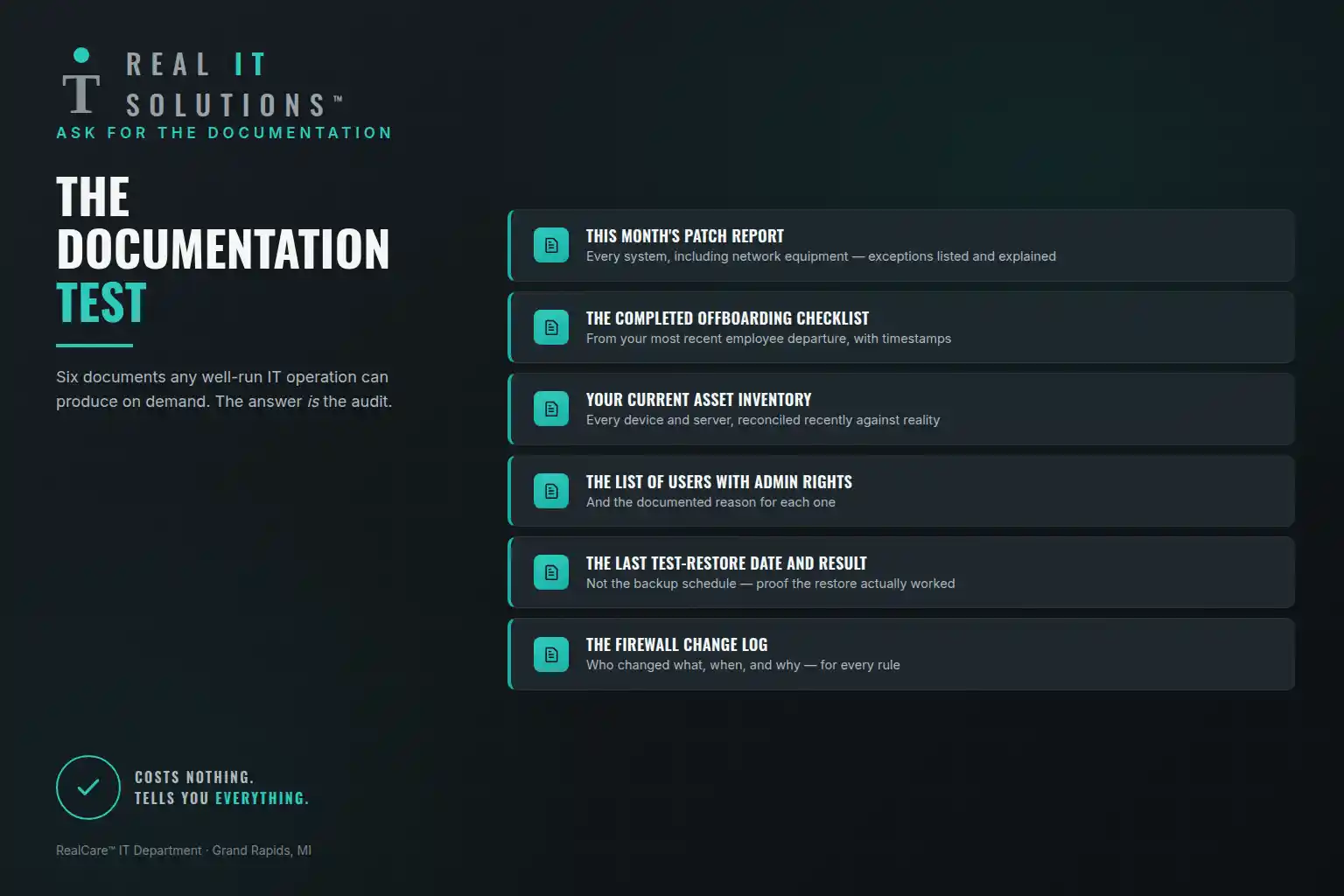
You do not need to audit configurations yourself. Ask whoever manages your IT — internal or outsourced — for six pieces of paper. A well-run operation produces them without scrambling:
- This month’s patch report, including network equipment — with any exceptions listed and explained.
- The completed offboarding checklist from your most recent employee departure.
- Your current asset inventory — every device and server, reconciled recently against reality.
- The list of users with admin rights, and the reason for each.
- The date and result of the last test restore from backup — not the backup schedule; the restore.
- The change log for your firewall — who changed what, when, and why.
Every document that appears quickly is evidence of an operation run to a standard. Every awkward pause is a gap an attacker would eventually have found for you. The test costs nothing, offends no one who is doing the job well, and tells you more than any sales presentation ever will.
FREQUENTLY ASKED QUESTIONS
Pushback We Actually Hear, Answered Honestly
Isn’t standardization overkill for a small business?
It is the opposite: standardization is how a small business gets enterprise-grade security without enterprise headcount. A 25-person company cannot afford a security team watching for one-off mistakes, which is precisely why it cannot afford the one-off mistakes. Baselines and checklists are cheap, and they do their work every day whether anyone is watching or not.
Doesn’t all this process slow everything down?
Standardization is slower on day one and dramatically faster every day after. Documented environments mean faster troubleshooting, faster onboarding, faster recovery, and fewer of the emergencies that actually destroy productivity. What feels fast — undocumented changes, shared admin passwords, “just this once” exceptions — is deferred downtime with interest.
We already invested in security tools. Isn’t that enough?
Tools are necessary; they are simply not sufficient. Layered technical defenses stop what they are designed to stop — but every tool assumes an environment consistent enough to protect. A firewall cannot help with the rule nobody remembers approving, and endpoint protection cannot cover the server missing from the inventory. Standardization is what makes your tools true.
How do I get from a messy environment to a standardized one?
Not all at once, and not with a big-bang project. The practical order: inventory first (know what exists), identity second (MFA everywhere, kill orphaned accounts, shrink the admin list), then patching, then documented baselines and change control, then scheduled verification. Each step reduces real risk on its own. A capable IT partner brings the templates and does the heavy lifting — that is literally what our onboarding process is.
STABILITY IS A CHOICE
The Real IT Solutions Standard
Technology should create stability, not uncertainty. I have built my career on that sentence, and standardization is what it looks like in practice: environments that behave the same way every day, prove their own state on paper, and refuse to accumulate the quiet inconsistencies that breaches are made of. It will never be exciting. It will never have a booth at a trade show. It is also, by the numbers, the most effective security investment a small business can make.
If you want to know where your environment stands, start with the six documents above — or let us run the test with you. Real IT Solutions provides a straightforward security and standards assessment for businesses across Grand Rapids and West Michigan: we map your environment against our documented baselines and show you exactly what exists, what’s missing, and what to fix first. No scare tactics — just the discipline, applied.
SOURCES
Where These Numbers Come From