
In nearly every first conversation I have with a West Michigan business owner, I hear some version of the same sentence: “We should be fine — we have antivirus and a firewall.”
It is said with complete confidence, and it is the most dangerous sentence in small-business cybersecurity.
A layered security model protects your business by stacking independent defenses on top of one another, so that when one control misses an attack, the next one catches it. No single tool can stop every threat, because attacks do not come through a single door. They arrive through email, stolen passwords, unpatched software, misconfigured networks, and simple human error — often several of these in the same incident. At Real IT Solutions, we build and manage security as an eight-layer system, and in this article I will walk through exactly what those layers are, the specific attack each one exists to stop, and why the layers only work when they are managed together.
KEY TAKEAWAYS
The Short Version, Up Front
- No single tool is sufficient. Ransomware appeared in 88% of breaches at small businesses in Verizon’s 2025 analysis — and most of those victims had antivirus and a firewall.
- Attacks exploit multiple weaknesses. The 2026 Verizon DBIR found 62% of breaches involved the human element — technology alone cannot close that gap.
- Layered security assumes failure. Each of the eight layers exists because another layer can and eventually will miss something.
- Layers must operate as one system. Eight unmanaged products are not eight layers — they are eight blind spots with invoices.
- Recovery is a layer, not an afterthought. Backup and disaster recovery is the layer that turns a catastrophe into a bad afternoon.
WHY “ANTIVIRUS AND A FIREWALL” STOPPED BEING ENOUGH
The Threat Landscape Moved — Most Defenses Didn’t
Fifteen years ago, that sentence was roughly true. Threats mostly arrived as malicious files, and a perimeter firewall plus endpoint antivirus covered the two doors that mattered. Those days are gone. Today’s attacks are engineered to go around your strongest control, not through it.
The numbers tell the story plainly. Verizon’s 2025 Data Breach Investigations Report found that ransomware was present in 88% of breaches at small and mid-sized businesses — more than double the rate at large enterprises — precisely because attackers know smaller organizations tend to rely on one or two tools. The 2026 edition of the same report found that 62% of all breaches involved the human element, that credential abuse appeared in 39% of breaches, and that 48% involved a third party such as a vendor or software supplier. Phishing remains the most common way in, and IBM’s 2025 Cost of a Data Breach Report puts the average U.S. breach at $10.22 million — with organizations taking an average of 241 days just to identify and contain an incident.
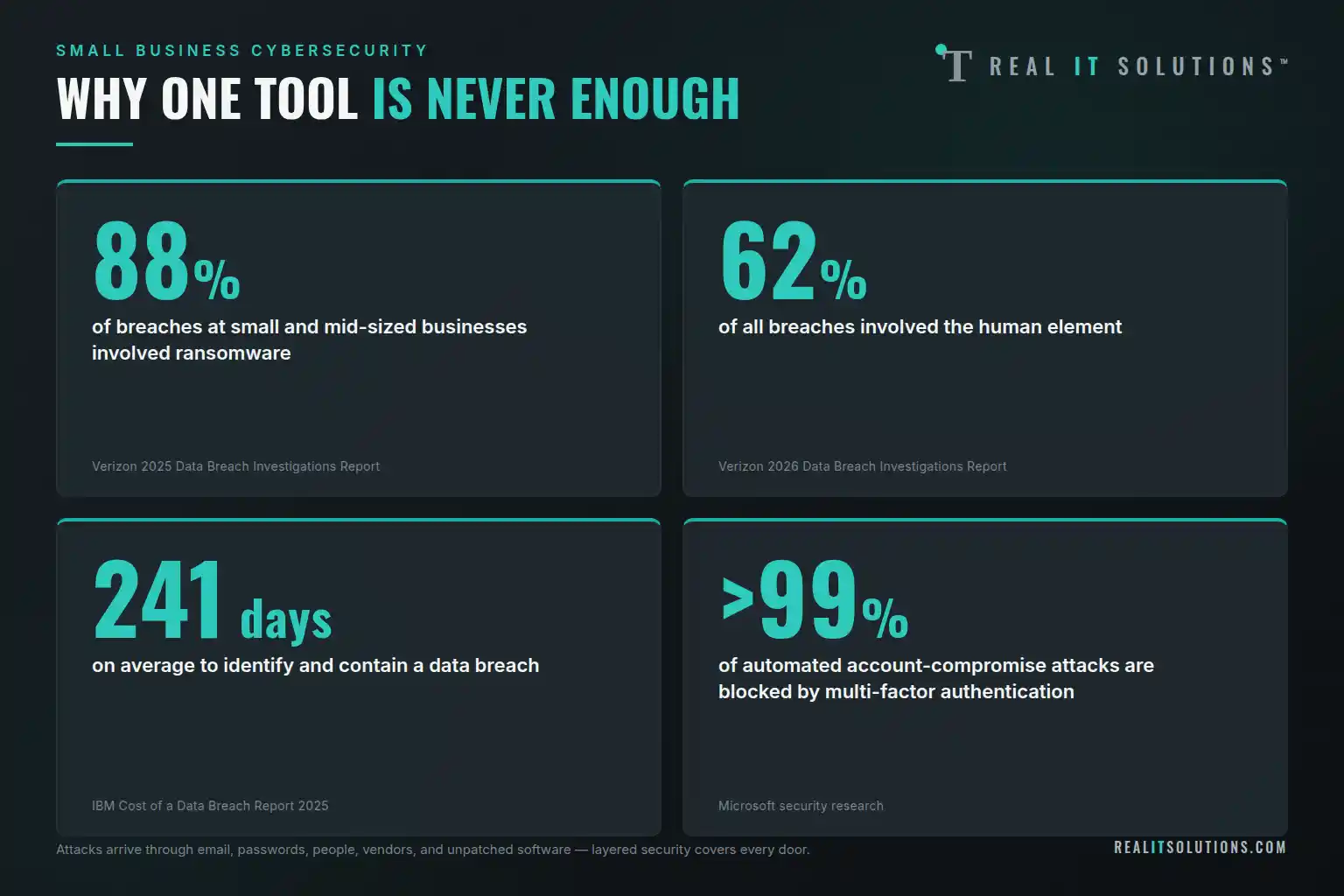
Look at those attack paths again: email, stolen passwords, people, vendors, unpatched software. Antivirus guards exactly one of those doors. A firewall guards another. Everything else is open.
WHAT IS A LAYERED SECURITY MODEL?
Defense in Depth, in Plain English
A layered security model — the industry term is defense in depth — is a strategy that places multiple independent, overlapping controls between an attacker and your data, so that no single failure results in a breach. Each layer addresses a different attack surface: devices, networks, identities, email, people, software, data, and time. The Cybersecurity and Infrastructure Security Agency (CISA) recommends exactly this approach for small and mid-sized businesses, because it is the only architecture that accounts for the one guarantee in security: something, somewhere, will eventually fail.
That last point deserves emphasis, because it is the part most businesses get backwards. Layered security is not built on the hope that every control works. It is built on the assumption that any control can fail — a filter misses an email, an employee clicks a link, a patch lags a week — and the system as a whole still holds.
THE EIGHT LAYERS — AND THE ATTACK EACH ONE EXISTS TO STOP
Eight Doors, Eight Guards
Here is the model we deploy and manage for our clients, layer by layer. The framework below is the one I wish every business owner had pinned above their desk.
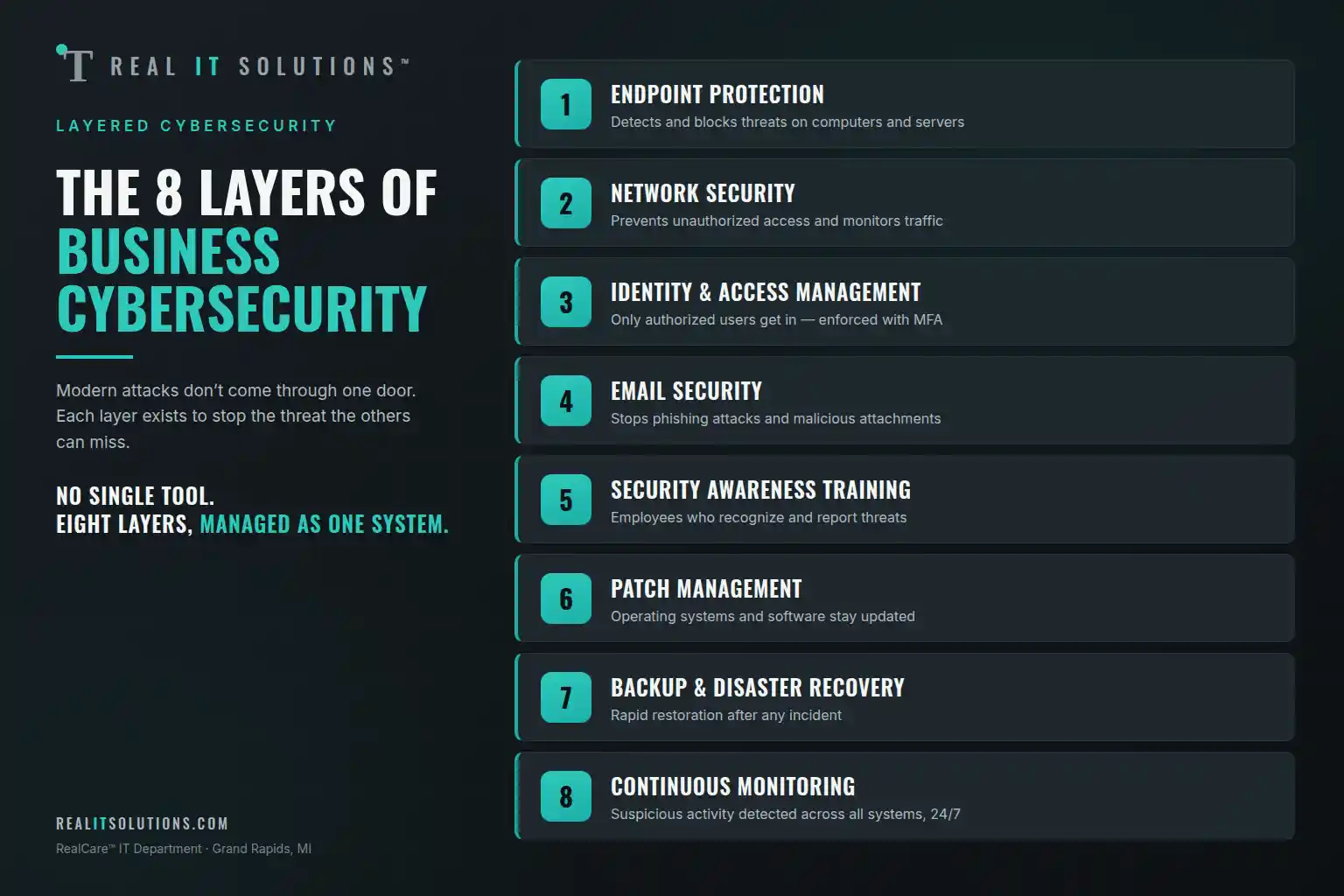
| # | Layer | What It Does | The Attack It Exists to Stop |
|---|---|---|---|
| 1 | Endpoint Protection | Detects and blocks threats on computers and servers | Malware and ransomware executing on a workstation or server |
| 2 | Network Security | Prevents unauthorized access and monitors traffic | Intruders moving laterally from one compromised device to everything else |
| 3 | Identity & Access Management | Ensures only authorized users access systems, enforced with MFA | Stolen or phished passwords being used to log in as you |
| 4 | Email Security | Stops phishing attacks and malicious attachments | The fraudulent invoice or fake login page that starts most breaches |
| 5 | Security Awareness Training | Teaches employees to recognize and report threats | Social engineering designed to make a person the point of entry |
| 6 | Patch Management | Keeps operating systems and software updated | Known vulnerabilities being exploited before they are fixed |
| 7 | Backup & Disaster Recovery | Enables rapid restoration after an incident | Ransomware or data loss becoming an extinction-level event |
| 8 | Continuous Monitoring | Detects suspicious activity across all systems | The quiet intrusion that dwells for weeks before striking |
A few of these layers deserve a closer look, because they are the ones most often missing when we assess a new client’s environment.
Identity Is the New Perimeter
Attackers rarely “hack in” anymore — they log in. With credential abuse appearing in 39% of breaches, multi-factor authentication is the single highest-leverage control most small businesses can add. Microsoft’s research has found that MFA blocks over 99% of automated account-compromise attempts. It is inexpensive, it is fast to deploy, and yet it is the layer we most frequently find absent.
Patching Is Boring, and That Is Why It Works
The 2026 DBIR found that only 26% of known exploited vulnerabilities were fully remediated during the year — down from 38% the year before. Attackers do not need a zero-day exploit when a one-year-old vulnerability is still open. A disciplined patch cadence quietly closes doors before anyone tries them.
Backup Is the Layer That Assumes All Others Failed
Immutable, tested, offsite backups are the difference between paying a ransom and declining to negotiate. This layer only counts if restores are tested on a schedule — a backup you have never restored is a rumor, not a recovery plan.
WHEN TWO LAYERS FAILED — AND THE THIRD HELD
A True Story, Suitably Anonymized
A composite example from real incidents we have handled, with details changed to protect the client. A West Michigan professional services firm received an email that appeared to come from a long-standing vendor, complete with accurate project references — the kind of tailored message AI tooling now makes trivial to produce. The email security layer scored it as suspicious but not malicious; it landed in the inbox. Layer one failed. An employee, busy and well-intentioned, clicked the link and entered their Microsoft 365 credentials into a convincing replica login page. Layer two — the human layer — failed.
Then the system did its job. The attacker attempted to sign in with the stolen credentials within the hour. Multi-factor authentication challenged the login, conditional access flagged the unfamiliar location, and the attempt died at the identity layer. Continuous monitoring alerted our team, the password was reset, and the incident was closed before lunch. Total business impact: one uncomfortable conversation and a fifteen-minute retraining. Without that third layer, the same event plays out as weeks of quiet mailbox surveillance, redirected invoices, and a five-figure loss — the standard business email compromise script.
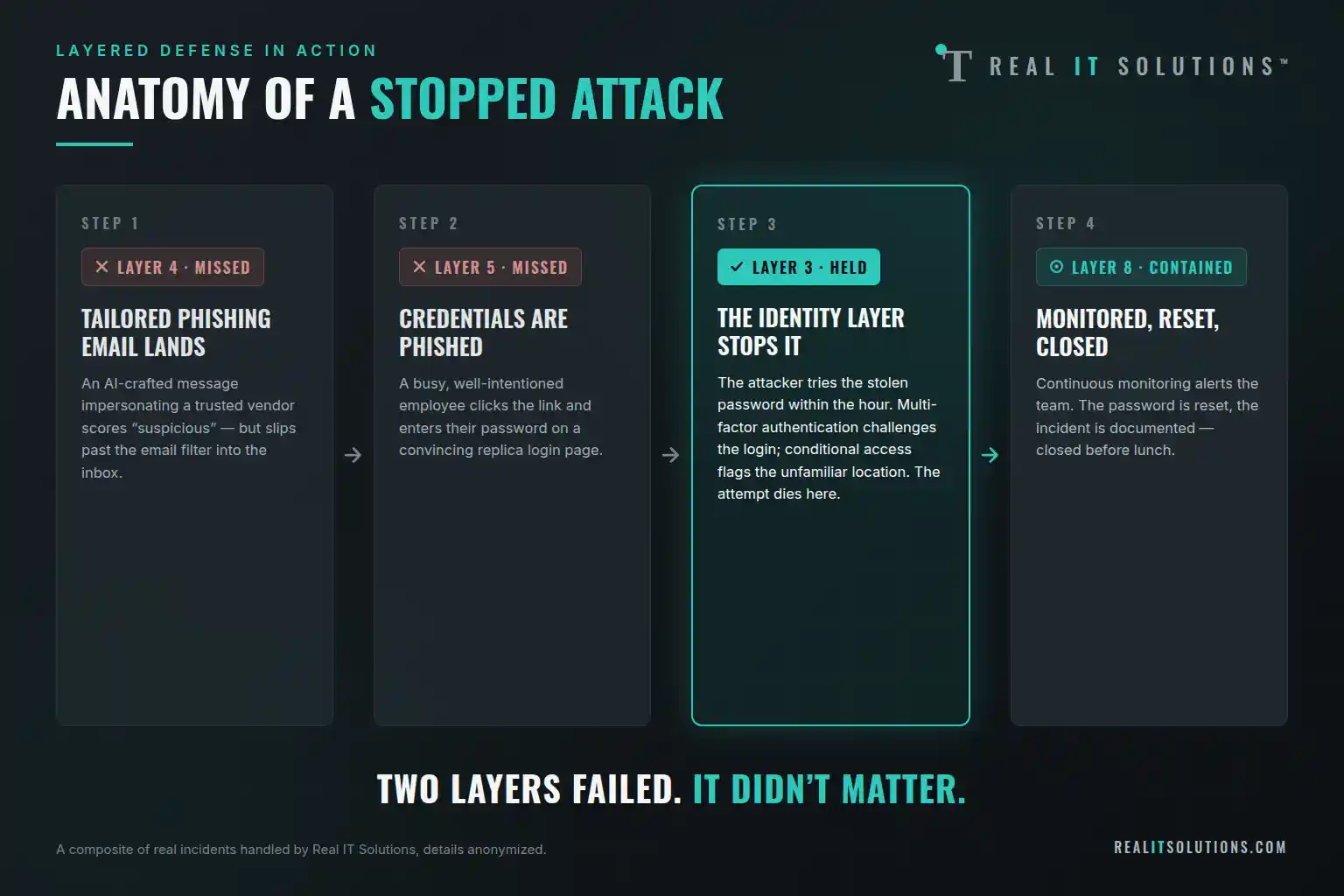
Two layers failed and it did not matter. That is not luck. That is architecture.
EIGHT PRODUCTS ARE NOT EIGHT LAYERS
You Can Buy the Parts. You Can’t Buy the System.
Here is the uncomfortable truth about layered security: you cannot buy it. You can buy the components, but a stack of security products with nobody accountable for watching, patching, testing, and tuning them is not defense in depth — it is expensive shelf-ware. Half of the layers in the model are not products at all. Patch management is a discipline. Training is a program. Backup verification is a standing process. Monitoring is only as good as the response behind it.
This is why we deliver security through our RealCare™ IT Department framework rather than as a list of licenses. The layers are deployed to a documented standard, monitored continuously, and maintained on a defined cadence — and when one layer flags something, a human being investigates it. The difference shows up exactly when it matters:
| Dimension | A Collection of Security Tools | A Managed Layered System |
|---|---|---|
| Coverage | Gaps between products nobody owns | Eight layers mapped to every attack surface, reviewed as one system |
| Alerts | Notifications go to an unwatched inbox | Monitored continuously; a person investigates and responds |
| Patching | Whenever someone remembers | Defined cadence, documented, verified |
| Backups | Assumed to work | Restore-tested on a schedule, immutable copies offsite |
| People | Annual slideshow, quickly forgotten | Ongoing training and phishing simulation with measurable results |
| After an incident | Finger-pointing between vendors | One accountable team, one documented playbook |
WHICH LAYERS IS YOUR BUSINESS MISSING?
An Honest Self-Audit, No Security Degree Required
You do not need a security background to audit yourself at a high level. Answer these eight questions honestly — every “no” or “I don’t know” is a layer that is thin or absent:
- Is every computer and server running managed endpoint protection that someone actually reviews?
- Is your network segmented and firewalled so one infected laptop cannot reach everything?
- Is multi-factor authentication enforced for email, remote access, and financial systems — for every user, no exceptions?
- Is inbound email filtered by a modern security service, not just the default spam folder?
- Have your employees been trained — and tested — on phishing in the last six months?
- Are operating systems and applications patched on a documented schedule?
- Have you successfully restored real files from backup in the last quarter?
- Would anyone be alerted tonight if something suspicious happened on your network at 2 a.m.?
FREQUENTLY ASKED QUESTIONS
What Business Owners Ask Us Most
Do I still need antivirus if no single tool is enough?
Yes. Every layer in the model matters — the point is not that antivirus is useless, but that it covers only one of eight doors. Modern endpoint protection remains the right tool for stopping malicious code on devices. It simply cannot stop a stolen password or a convincing phone call.
What is the single most important layer?
The one you are missing. That is the honest answer, because attackers find the gap, not the strength. If you force me to choose where most small businesses should start, it is identity and access management with enforced MFA, followed immediately by tested backups — the layer that saves you when everything else fails.
Isn’t eight layers of security expensive for a small business?
It costs a fraction of one incident. U.S. breach costs average in the millions, but the figure that matters for a 20-person company is simpler: days of downtime, payroll with no revenue, and clients asking whether their data is safe. A managed layered program is a predictable monthly number; a breach never is.
How do I know if my current IT provider covers all eight layers?
Ask them to show you — in writing. Which product or process covers each layer, when patches were last applied, when a restore was last tested, and who receives alerts at night. A capable provider will have this documented before you ask. If the answer is vague, that vagueness is itself the assessment.
SECURITY SHOULD CREATE STABILITY, NOT UNCERTAINTY
The Real IT Solutions Standard
I have spent my career on a simple conviction: technology should create stability, not uncertainty. When systems are designed correctly and managed proactively, businesses can operate with confidence — and layered security is that principle applied to threats. Not a pile of products and hope, but eight deliberate layers, each assuming the others can fail, all managed as one accountable system.
If you are not certain which of the eight layers your business has — or you suspect the honest answer is “two” — we should talk. Real IT Solutions provides a straightforward security assessment for businesses across Grand Rapids and West Michigan that maps your current environment against all eight layers and shows you exactly where you stand. No scare tactics; just the framework above, applied to your business.
SOURCES
Where These Numbers Come From