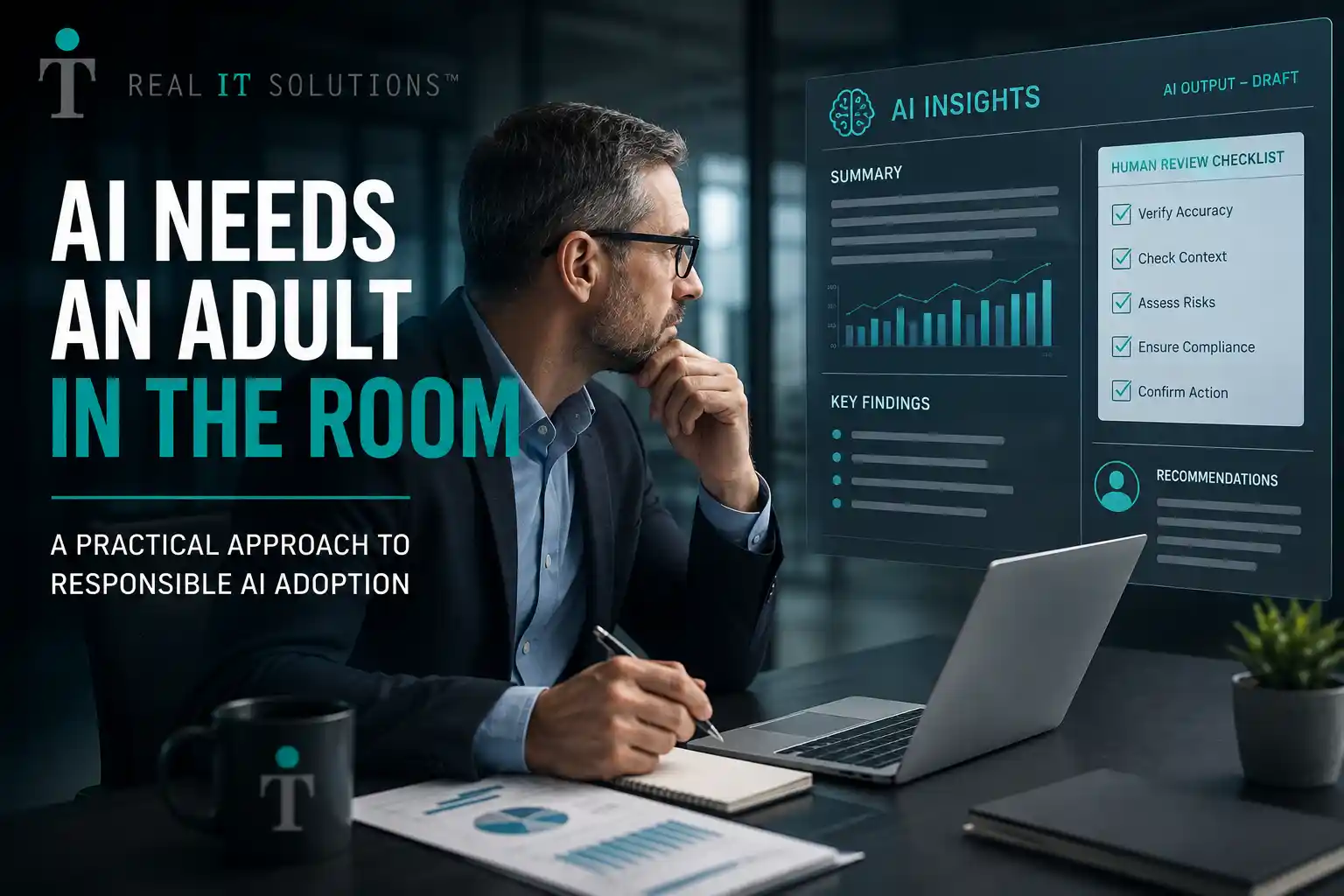
AI Needs an Adult in the Room: A Practical Approach to Responsible AI Adoption
By Matt Kahle, CEO & Co-Founder, Real IT Solutions
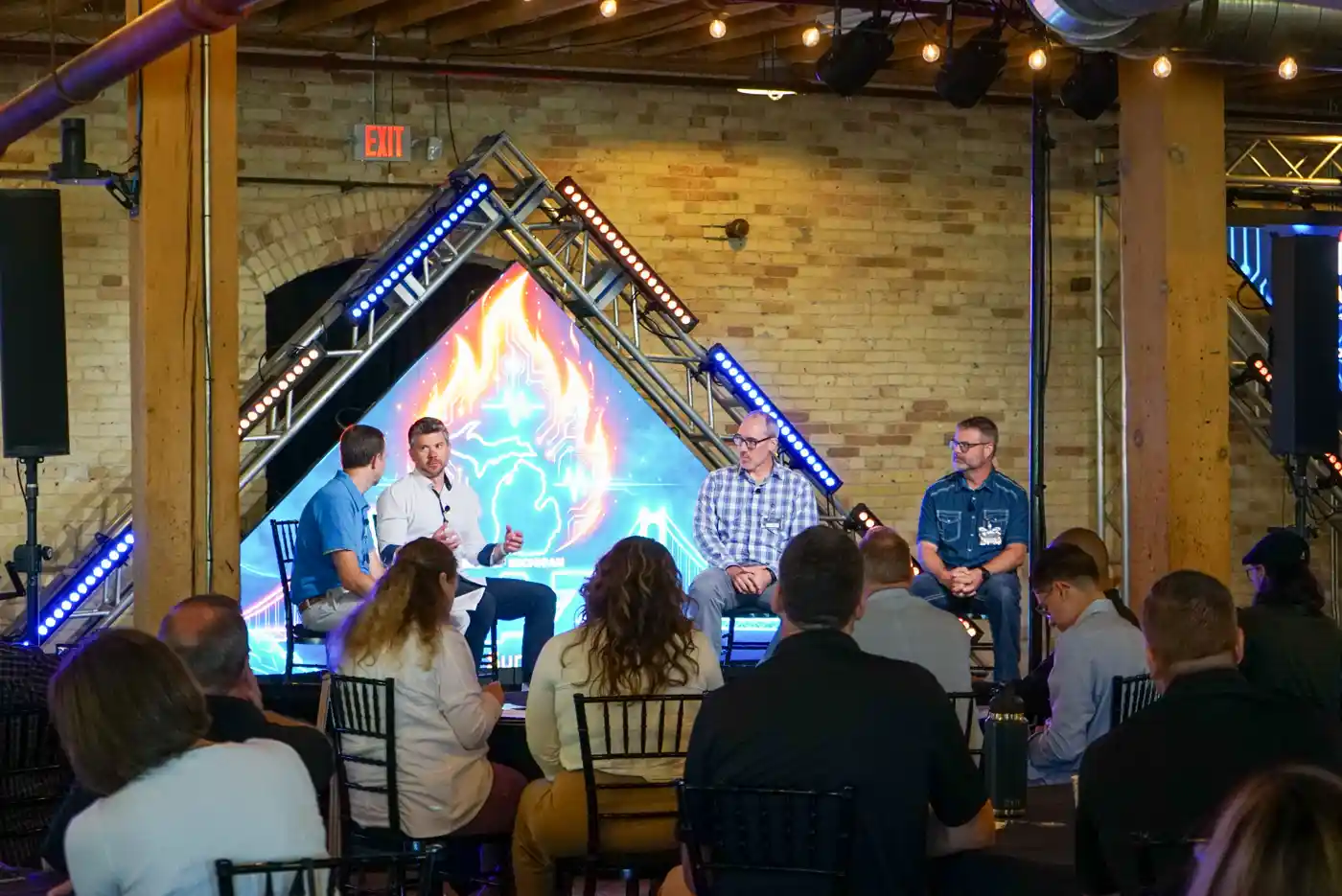
A few weeks ago, I participated in the panel Q&A discussion at the Better Business Bureau of Michigan’s BLAZE AI Summit in Grand Rapids.
The event brought together business leaders, technology professionals, AI strategists, marketers, and cybersecurity experts to talk about how organizations can move beyond experimenting with artificial intelligence and start using it productively and responsibly.
That reinforced something I have been telling business leaders for a while:
AI can be extraordinarily capable. But it still needs an adult in the room.
As generative AI becomes part of everyday business operations, the question is no longer simply, “Should we use AI?”
The better questions are:
- What work should we give to AI?
- What decisions should remain with people?
- What company data should an AI system be allowed to access?
- How do we govern AI without creating unnecessary bureaucracy?
- How do we turn AI productivity into actual business value?
Those are questions about responsible AI adoption, not simply technology.
What Does Responsible AI Adoption Actually Mean?
Responsible AI adoption means using artificial intelligence to improve business performance while maintaining appropriate human oversight, cybersecurity, data protection, and accountability.
That distinction matters.
Generative AI tools such as ChatGPT, Microsoft Copilot, Claude, and Gemini can perform increasingly sophisticated tasks. The large language models and other AI technologies behind these systems can summarize information, draft content, analyze documents, generate software, identify patterns, and accelerate many types of knowledge work.
But technical capability does not eliminate business responsibility.
Someone still has to decide:
Should AI be doing this task in the first place?
And someone still needs to be accountable for the result.
That is where AI governance and the human in the loop become critical.
AI Governance Is Easier Than It Sounds and More Important Than You Think
One of the BLAZE AI Summit sessions I attended focused on AI governance and compliance.
My biggest takeaway was that AI governance can be much simpler than the term makes it sound, while also being much more important than many businesses realize.
Governance does not have to begin with a hundred-page policy.
For a small or midsize business, it can start by answering practical questions:
- Which AI tools are approved for business use?
- What customer or company data can employees put into those tools?
- What information should never be entered?
- Which AI-generated outputs require human review?
- Who is responsible when AI contributes to a business decision?
- How will the organization identify unauthorized or “shadow AI” use?
- How do cybersecurity, privacy, and regulatory requirements affect AI use?
These are guardrails.
They allow employees to use AI more confidently because everyone understands the boundaries.
There are also established resources businesses can use as a reference. The National Institute of Standards and Technology’s AI Risk Management Framework (NIST AI RMF), for example, provides a voluntary framework for managing AI risk.
The framework organizes AI risk management around four core functions: Govern, Map, Measure, and Manage.
NIST has also published an Artificial Intelligence Risk Management Framework: Generative Artificial Intelligence Profile addressing risks and risk-management considerations specific to generative AI systems.
A small business does not need to turn that framework into a compliance exercise overnight. But the principles reinforce an important point:
AI risk needs to be managed intentionally.
Why Human-in-the-Loop AI Matters
During the panel discussion, I used an analogy that describes my view of generative AI pretty well.
Generative AI is like a seven-year-old who can do rocket science.
It might be capable of plotting a course to the moon and back but still need help tying its shoes.
That apparent contradiction is one of the most important things business leaders need to understand about AI.
An AI system can perform something remarkably sophisticated and then make a surprisingly basic error.
It may misunderstand context.
It may make an incorrect assumption.
It may produce an answer that sounds authoritative even when someone with subject-matter expertise would immediately recognize a problem.
That is why human-in-the-loop AI, sometimes abbreviated HITL, is so important.
Human-in-the-loop means a person remains involved at appropriate points in an AI-assisted process to provide context, evaluate outputs, make judgments, and remain accountable for the result.
I describe that person a little less formally as:
The Adult in the Room.
AI can do the analysis.
A person should understand what the analysis means.
AI can recommend options.
A person should determine which option makes sense.
AI can generate the first draft.
A person should decide whether that draft is accurate, appropriate, and worth putting their name on.
The objective is not to keep humans involved in every keystroke.
It is to keep humans involved where judgment matters.
AI Should Improve Human Connection, Not Replace It
Another BLAZE session explored using AI to identify target audiences, develop messaging, and market more effectively.
What stayed with me was the emphasis on quality over quantity and keeping a person involved in the connection.
AI makes producing more incredibly easy.
- More emails.
- More social posts.
- More prospecting messages.
- More proposals.
- More content.
But if every business uses AI simply to generate ten times more communication, we have not improved communication.
We have created ten times more noise.
The better use of AI is to help people prepare more effectively for meaningful interactions.
AI might summarize a customer’s history before a meeting.
It might research an industry before a salesperson makes a call.
It might help a subject-matter expert organize ideas before writing an article.
It might identify patterns within customer feedback that a leadership team should investigate.
In those examples, AI improves the quality of the human interaction instead of attempting to eliminate it.
That is a fundamentally different way of thinking about automation.
Flipping the Pyramid of Work
One framework I like for explaining this comes from AI strategist Dan Chuparkoff and his Pyramid of Work.
The model breaks work into several levels:
- Communicate
- Process
- Investigate
- Solve
- Decide
- Imagine
The problem is that many people spend a disproportionate amount of their workday in the lower portion of the pyramid: communicating routine information, processing information, and investigating things before they can begin solving the actual problem.
Chuparkoff’s framework proposes using AI to assist with more of those lower-level activities so people can devote more time to problem solving, decision-making, and imagination.
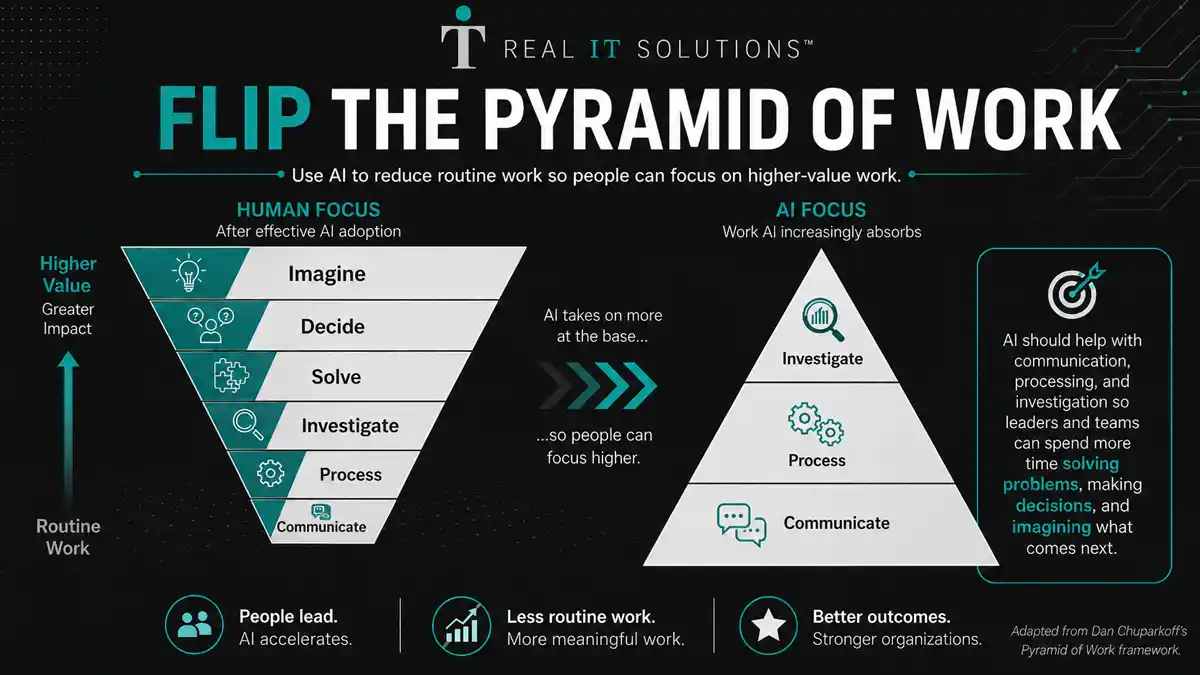
Adapted from Dan Chuparkoff’s Pyramid of Work framework.
That is the AI future I find most interesting.
Not replacing a person.
Moving the person higher up the pyramid.
AI handles more communication, processing, and investigation.
People spend more time solving, deciding, and imagining.
That is where organizations can begin generating meaningful productivity gains rather than simply automating isolated tasks.
It also brings us right back to the need for the Adult in the Room.
AI can gather the information.
People determine what it means.
AI can generate the options.
People determine which option makes sense.
AI can accelerate the work.
People remain accountable for the outcome.
What Business Tasks Should We Actually Give to AI?
This leads to another important question:
Which tasks should a business automate with AI, and which should remain with people?
At Real IT Solutions, our AI Business Optimization Services approach this as a business decision before making it a technology decision.
The objective is to identify where AI can remove repetitive or time-consuming work without giving away the judgment, relationships, or accountability that create business value.
Good candidates for AI assistance often include:
- Summarizing meetings and documents
- Organizing information
- Initial research
- Drafting routine communications
- Classifying or sorting information
- Creating first drafts
- Documenting processes
- Identifying patterns in large amounts of information
Tasks requiring more caution include:
- High-impact financial decisions
- Legal or regulatory judgments
- Personnel decisions
- Sensitive customer communications
- Cybersecurity decisions
- Decisions requiring professional licensure
- Work where a person’s experience, reputation, or relationship is central to the outcome
That does not mean AI cannot assist with higher-stakes work.
It means the Adult in the Room becomes more important as the consequences increase.
AI Readiness Should Come Before AI Deployment
One of the biggest mistakes businesses can make is beginning with the tool.
Someone sees a new AI application and asks:
“How can we use this?”
I would reverse the question.
“Where in our business are people spending time on work that AI could help them perform faster, better, or more consistently?”
Then ask what is required to do that safely.
That may involve:
- AI readiness
- Clean and accessible business data
- Cybersecurity controls
- Data governance
- Documented workflows
- AI policies
- Employee training
- Appropriate technology infrastructure
- Change management
- Defined human review
- Measurement of business outcomes
It also means understanding shadow AI: employees adopting consumer AI tools independently before the business has determined what tools are appropriate or what information they are permitted to share.
Real IT Solutions helps businesses address these questions through AI readiness, AI governance, data preparation, workflow optimization, AI implementation, and employee training.
That is why I do not think an AI strategy should start with buying more software.
It should start with understanding the business.
The Goal Is Not More AI. It Is Better Work.
The BLAZE AI Summit reinforced my optimism about what artificial intelligence can do for Michigan businesses.
But successful AI adoption will require more than access to powerful technology.
It will require businesses to combine:
- AI capability with human judgment.
- Automation with accountability.
- Productivity with governance.
- Technology with people.
The organizations that get the most value from AI will not necessarily be the ones that automate the most work.
They will be the organizations that make good decisions about which work AI should handle and which work still requires people.
Use AI to reduce the routine work.
Use it to accelerate investigation.
Use it to give people better information.
Then let people spend more of their time solving problems, making decisions, building relationships, and imagining what comes next.
That is how we flip the pyramid.
And for the foreseeable future, there should still be an Adult in the Room.
Frequently Asked Questions About Responsible AI Adoption
What is responsible AI adoption?
Responsible AI adoption is the use of artificial intelligence to improve business outcomes while maintaining appropriate human oversight, cybersecurity, data privacy, governance, and accountability. The goal is not simply to deploy AI tools, but to determine where AI creates value and how its risks will be managed.
What does human-in-the-loop AI mean?
Human-in-the-loop AI means a person remains involved at important stages of an AI-assisted process. The human provides context, reviews outputs, makes judgment calls, and remains accountable for the final decision or action.
Why does AI governance matter for small and midsize businesses?
AI governance establishes practical rules for how employees can use artificial intelligence, which tools are approved, what information can be shared with those tools, and where human review is required. Governance can reduce cybersecurity, privacy, compliance, and operational risk while giving employees clearer guidance for using AI productively.
What is shadow AI?
Shadow AI is the use of AI applications by employees without formal approval or oversight from the organization. It can create risk when employees enter customer information, intellectual property, confidential business data, or other sensitive information into tools the organization has not evaluated.
What types of work are best suited to AI?
AI is particularly useful for high-volume or repetitive activities such as summarizing, processing information, conducting preliminary research, organizing data, and creating first drafts. Human involvement becomes increasingly important as a task requires professional judgment, accountability, relationships, or high-impact decision-making.
What should a business do before deploying generative AI?
Start by identifying the business problem rather than selecting a tool. Evaluate AI readiness, business data, existing workflows, cybersecurity, governance requirements, employee skills, and the points where human review will be required. From there, select and deploy technology that supports a defined business objective.
Ready to Find Out Where AI Actually Fits in Your Business?
AI Business Optimization for West Michigan Businesses
Real IT Solutions helps small and midsize businesses identify practical AI opportunities, assess readiness, establish AI governance, protect business data, implement AI tools, and train employees to use them effectively.